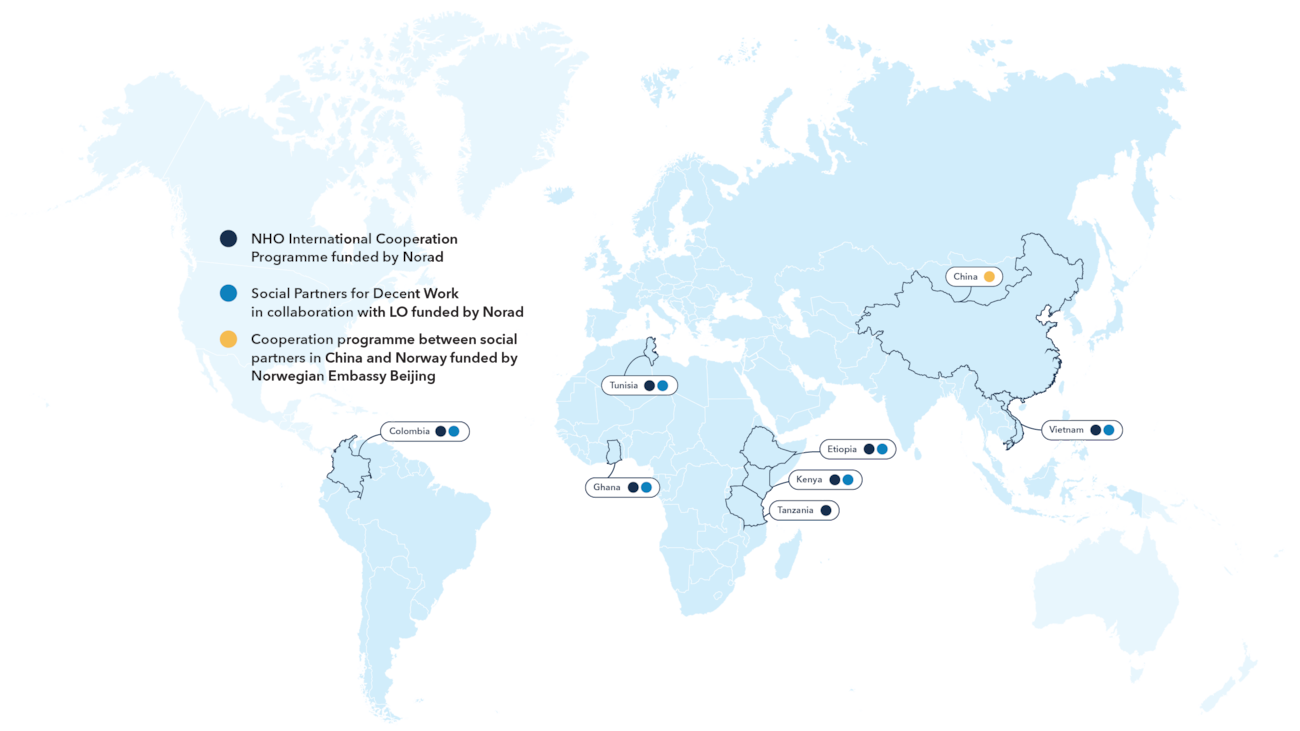
As of 2026, NHO ICP has active partnerships in Ghana, Kenya, Tanzania, Tunisia, Ethiopia, Vietnam, China, and Colombia.
What we aim to achieve
Our goal is straightforward: contributing to a stronger private sector that creates more jobs, raises business standards, and competes internationally. We work towards four outcomes, each linked to what businesses need to grow and succeed:
- Better business environments
We work with partner organisations to reduce compliance burdens, improve workplace safety standards, and strengthen the regulatory frameworks that businesses operate within. We also cooperate closely with the Norwegian trade union (LO) to address the importance of social dialogue and tripartite collaboration between employers, workers and government. When the rules are clear, consistent, and fairly enforced, private sector investment follows. This contributes to SDG 8 on sustained economic growth and decent work.
- A workforce that meets industry needs
Talent gaps are one of the biggest barriers to business growth in emerging markets. We support employer-led skills initiatives where private sector contributes directly with know-how, strengthen vocational training systems, and help businesses shape the curricula that will produce their future workforce. We help to expand the pipeline of women entering Science, Technology, Engineering and Mathematics (STEM) careers - addressing both a skills shortage and a gender gap. This contributes to SDG 8 and SDG 5.
- Businesses ready for international markets
Accessing international trade and investment requires meeting global standards. We build capacity in anti-corruption and anti-bribery practices - and support companies in adopting ESG reporting frameworks that satisfy the expectations of international partners and investors. This contributes to SDG 8 on sustained economic growth.
- Women in leadership
Companies with diverse leadership outperform those without. Through the Female Future Programme, our partner organisations offer trainings that equip women with skills and motivation to take on senior management and board roles. The programme is self-financed in Tanzania, Kenya, Uganda, and Ghana - driven by private sector contribution from companies that choose to invest in it because they understand the business case/ opportunities this initiative can unlock. This contributes to SDG 5 on gender equality and SDG 8 on inclusive economic growth.
How we work
ICP works through NHO's network of sister organisations - employer federations and chambers of commerce that sit at the centre of the private sector in their countries. We bring in technical expertise from NHO and Norwegian businesses, and we connect partner organisations with each other so that what works in one country can be applied in another, through replicable, scalable models.
We are a platform for organisation-to-organisation, and business-to-business knowledge transfer, built on long-term relationships, local ownership, and a shared belief that a strong private sector is the most powerful driver of sustainable development.
Our network
ICP operates as part of a wider ecosystem of organisations working to unlock the potential of private sector development in emerging markets. We coordinate and collaborate with Team Norway institutions like Norwegian embassies and Innovation Norway in partner countries. We are close to our Nordic counterparts, and international stakeholders - to align activities, act complementary to each other, share knowledge, and avoid duplication across the countries in which we are all active.
We are also linked with the International Labour Organization (ILO) and its Bureau for Employers' Activities (ACT/EMP), as well as the International Organisation of Employers (IOE). Through NHO's Pådriverforum, we maintain an active dialogue with NHO member companies, the Norwegian Ministry of Foreign Affairs and the Ministry of Trade and Industry on how development cooperation and international business interests can be better aligned.
NHO ICP is funded by the Norwegian Agency for Development Cooperation – Norad, and by funding directly from Norwegian Embassies.
Om NHO Internasjonalt Samarbeidsprogram (ICP)
NHO ICP kobler norsk næringslivskompetanse med arbeidsgiverorganisasjoner og private aktører i Afrika, Asia og Latin-Amerika. Siden 2002 har vi arbeidet side om side med lokale bedrifter og arbeidsgiverorganisasjoner for å skape grunnlaget for bærekraftig økonomisk vekst, anstendig arbeid og konkurransedyktige markeder.
Målet vårt er enkelt: å bidra til et sterkere næringsliv som skaper flere jobber, hever forretningsstandarder og konkurrerer internasjonalt.
Per 2026 har NHO ICP aktive partnerskap i Ghana, Kenya, Tanzania, Tunisia, Etiopia, Vietnam, Kina og Colombia.
Slik arbeider vi
- ICP arbeider gjennom NHOs globale nettverk av søsterorganisasjoner – arbeidsgiverforbund og handelskamre som står sentralt i næringslivet i sine land. Vi bringer inn faglig ekspertise fra NHO og norske bedrifter, og vi kobler partnerorganisasjonene sammen slik at det som fungerer i ett land kan anvendes i et annet, gjennom skalerbare modeller.
Vi er en plattform for kunnskapsoverføring mellom organisasjoner og bedrifter, bygget på langsiktige relasjoner, lokalt eierskap og en felles overbevisning om at et sterkt næringsliv er den viktigste drivkraften for bærekraftig utvikling.
Programmet finansieres av Norad og gjennomføres i samarbeid med lokale næringslivsorganisasjoner.